
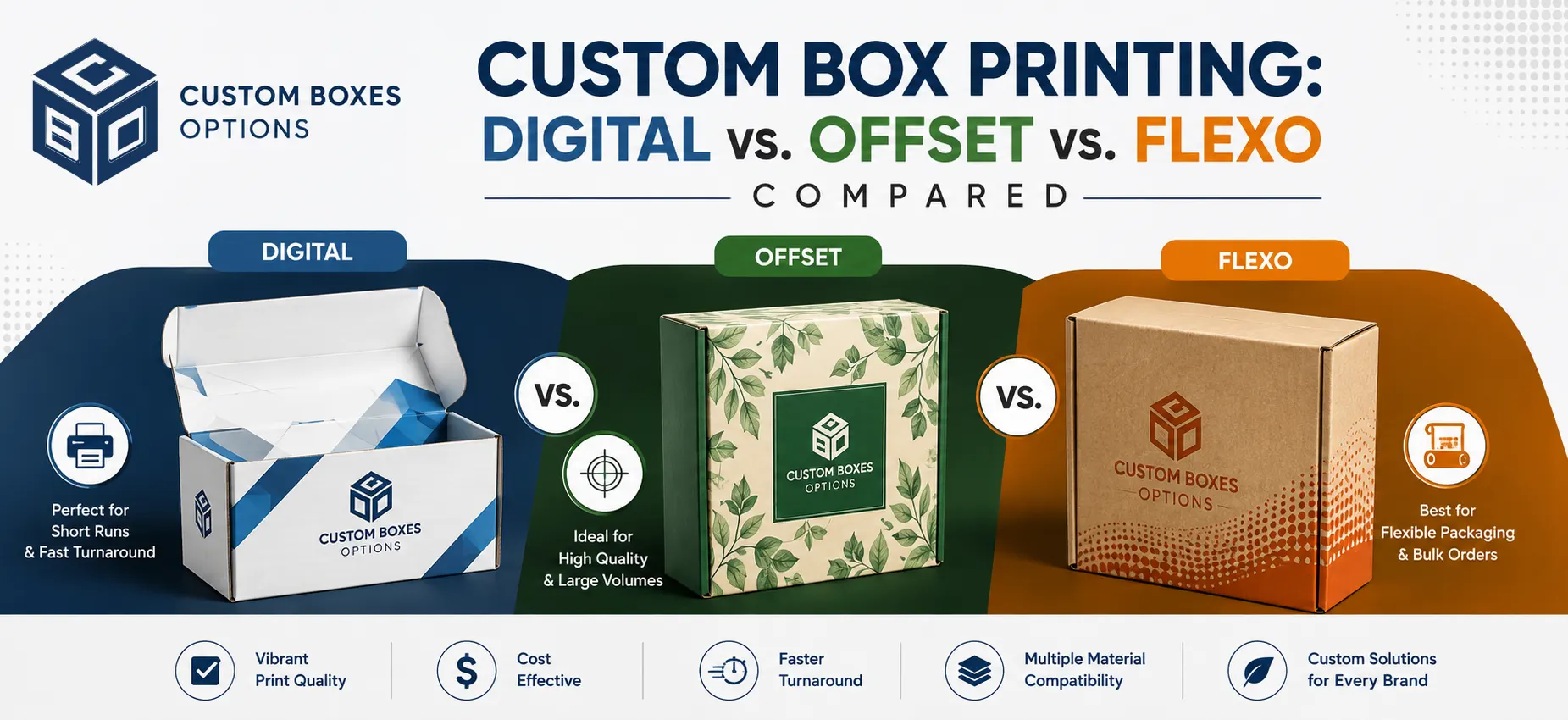
Every quote we send at CBO – Custom Boxes Options for custom box printing has a printing method sitting behind the number, and it is usually the single biggest reason two packaging suppliers can price the same box hundreds of dollars apart. One shop is running your artwork digitally. Another is quoting plates and a press setup. A third is printing straight onto corrugated on a flexo line built for fifty thousand units. Same box. Same artwork. Three very different cost structures.
Most buyers never see that layer. They see a price, a lead time, and a proof. But once you understand what each process is physically doing to the board, the quotes stop looking random, and you can start asking for the method that fits your run instead of accepting whatever the custom packaging manufacturer happens to have idle that week.
This guide breaks down all three, based on what we actually see come off the presses.
The short version, before we get technical
Digital printing puts ink or toner directly onto the sheet with no plates. Offset lithography transfers ink from a plate to a rubber blanket and then to the sheet. Flexography uses a raised, flexible plate that presses ink directly onto board, usually corrugated, usually at speed.
Setup cost climbs from digital to offset to flexo. Per-unit cost falls in the same direction. Where those two lines cross is where your decision lives.
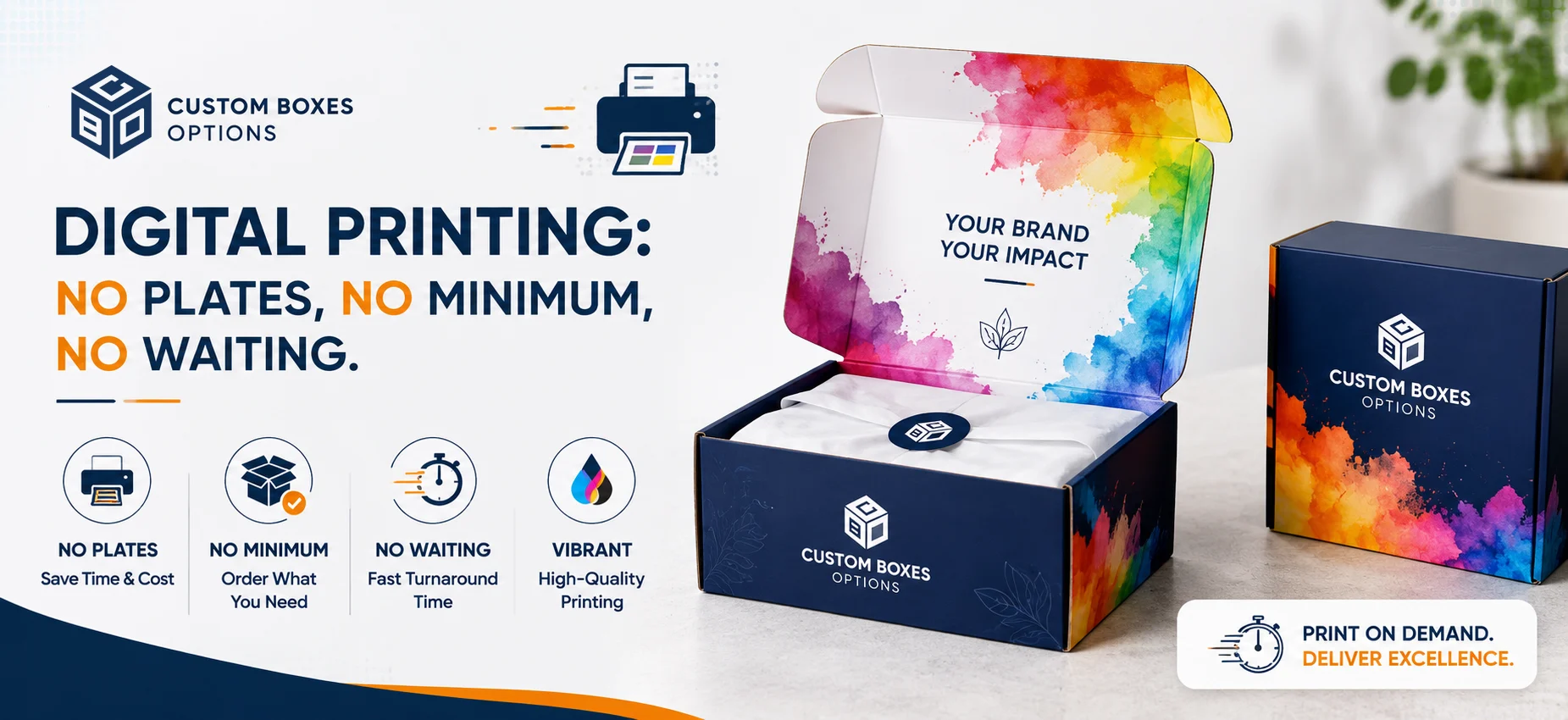
Digital printing: no plates, no minimum, no waiting
Digital presses skip plate-making entirely. Your PDF goes to the RIP, the press lays down toner or inkjet, and the first sheet out of the machine is a sellable sheet. That one difference drives everything else about the process.
1. What does it do well?
Short runs are the obvious case. If you need 100 boxes, our standard minimum here, the plates would cost more than the boxes. Digital carries no plate charge, so a run of 100 and a run of 1,000 have roughly the same unit economics.
Variable data is the underrated case. Because every sheet is imaged independently, you can change the artwork sheet to sheet at no extra cost. Regional versions, seasonal artwork, numbered limited editions, QR codes that differ per unit, a dozen SKUs printed in one pass instead of a dozen separate runs. Brands running our dessert and bakery packaging range use this constantly: one box design, six flavor variants, no six separate setups.
Speed follows from the same thing. No plates means no plate-making step, which typically pulls three to five days out of the schedule.
2. Where does it cost you?
Per-unit price stays flat as volume grows. That flatness is a gift at 200 units and a problem at 20,000, where offset or flexo would have dropped well below it.
Color is the other constraint. Most digital presses build color from the CMYK process, which means true spot colors are simulated rather than matched. If your brand red is a specific Pantone and your legal team cares about it, digital will get close, often close enough, but it is a conversion, not a match. Extended gamut presses with orange, green, and violet stations close much of that gap, though not every shop has one.
Sheet size caps out lower than offset, which matters for large shipper cartons but rarely for retail-sized boxes.
Offset lithography: the quality benchmark for custom box printing
Offset is the process behind almost every high-end retail box you have ever picked up. Ink is transferred from an aluminum plate to a rubber blanket, and from the blanket onto the sheet, hence “offset,” because the plate never touches the paper.
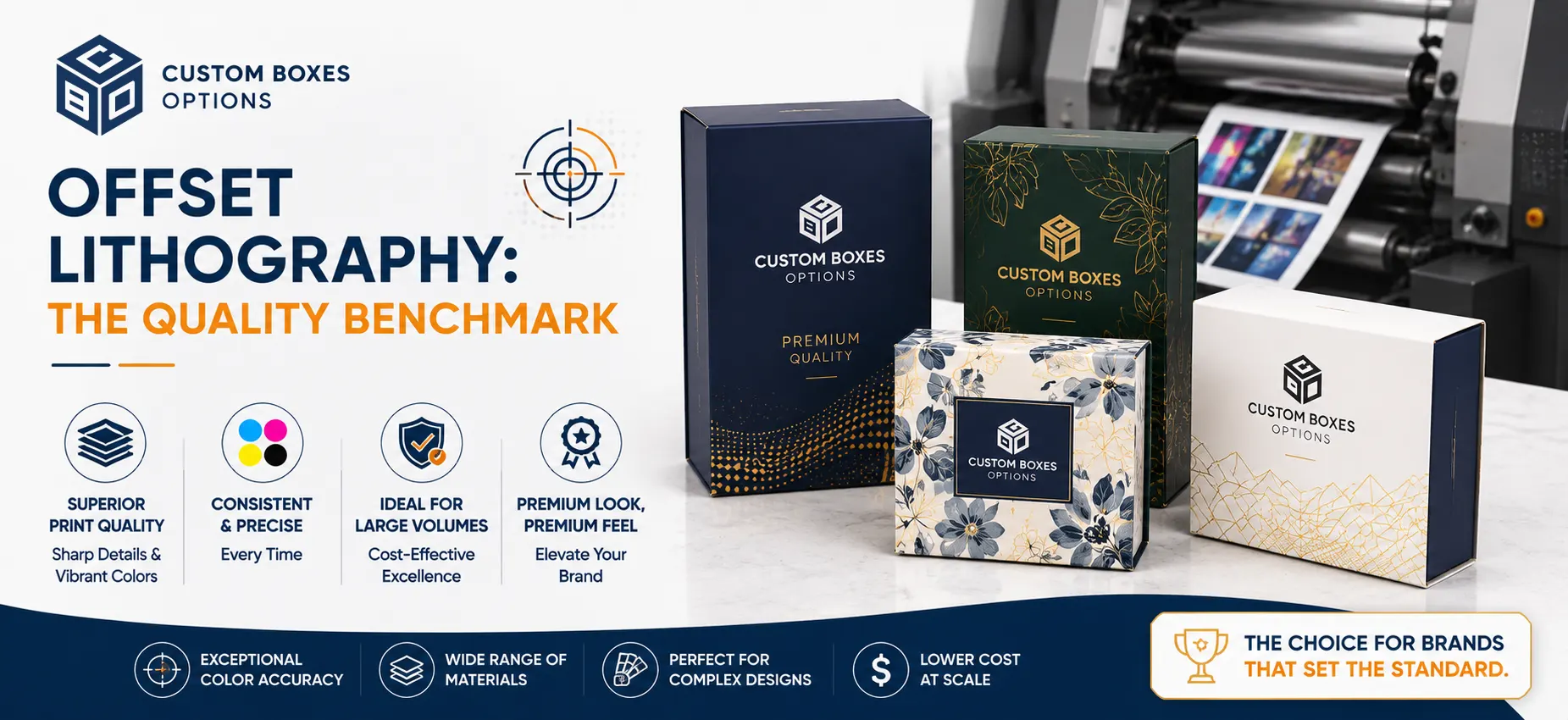
That indirect transfer is what produces the fine detail offset is known for. Screen rulings of 175 to 200 lines per inch are routine, which means photographic imagery, subtle gradients, and small reversed-out type all hold up under a loupe.
Spot color and finishing
Offset runs true spot inks. Your Pantone is mixed as a physical ink and printed as that ink, not built from four process colors. For brands where color consistency across production runs is a real commercial issue, this is the deciding factor.
It also plays best with premium finishing. Soft-touch lamination, spot UV, foil stamping, embossing, and metallic inks all sit naturally in an offset workflow. The rigid boxes, cosmetic cartons, and gift packaging that feel expensive in hand are almost always offset-printed.
How it reaches corrugated
Offset presses print on flat sheets, not fluted board. To get an offset image onto a corrugated shipper, printers use litho lamination: the graphic is offset-printed on a paper liner, then laminated to the corrugated sheet before die-cutting. Beautiful result, extra step, extra cost.
The trade-off
Plates. Every color needs one, and each plate carries a setup charge and press-ready time. At 300 units, that overhead is brutal per box. At 5,000, it disappears into the run. Offset’s sweet spot generally starts somewhere in the low thousands and climbs from there. Lead times also run longer; plate production, makeready, and drying time before finishing all add days.
Flexography: built for volume on corrugated custom box printing
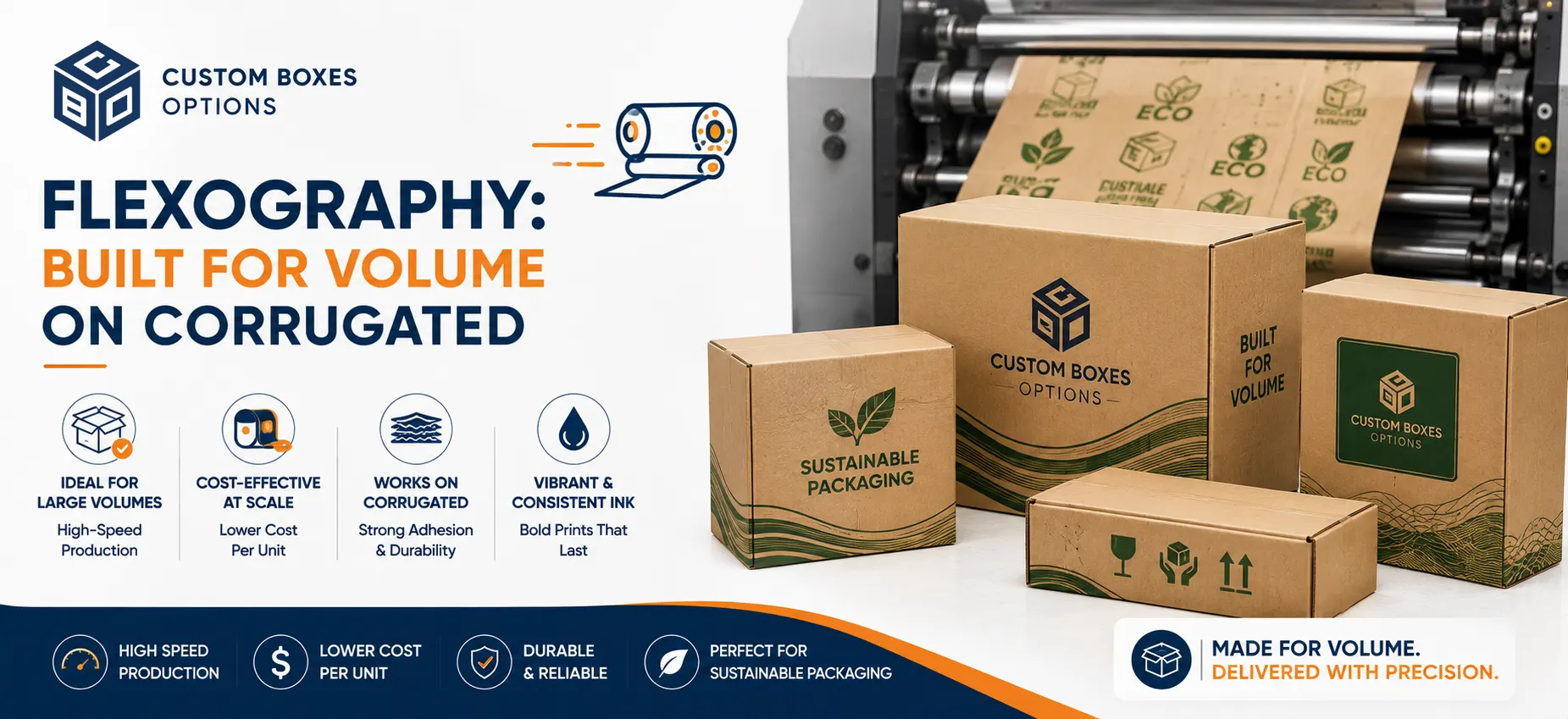
Flexo uses flexible photopolymer plates mounted on rotating cylinders. An anilox roller, a ceramic cylinder engraved with thousands of tiny cells, meters a precise ink film onto the plate, which presses directly onto the substrate.
Because the plate is soft and the impression is light, flexo can print directly onto fluted corrugated without crushing it. That is the whole reason it dominates shipping and bulk food packaging.
Why volume buyers choose it
Flexo presses run fast and run inline. Printing, die-cutting, slotting, folding, and gluing can happen in one continuous pass, which is why the per-unit cost on long runs is so hard to beat. Above roughly 10,000 units, flexo is usually the cheapest way to get a printed corrugated box.
The inks are typically water-based, which dry fast, carry lower VOCs, and are well suited to direct food-contact adjacent applications. Businesses ordering high-volume kraft and food-service papers see the same economics; flexo on a web press is what makes those unit prices possible.
The constraints to plan around
Detail is coarser. Flexo has closed much of its historic quality gap, and high-definition flexo now handles surprisingly fine work, but standard direct-print flexo on corrugated still cannot match offset’s fine screens. Small type, tight registration between colors, and photographic imagery are where it strains.
Plate costs are real and rise per color, so most flexo designs use a limited palette, often two to four solid colors, with bold shapes rather than gradients. The design of the process and flexo looks excellent. Design against it, and it looks cheap. Setup waste is higher too. Getting registration and ink density dialed in consumes board, which is another reason short runs are uneconomical.
Side-by-side comparison
| Factor | Digital | Offset | Flexo |
|---|---|---|---|
| Plates required | None | One per color | One per color |
| Economical run length | 50 – 2,000 | 2,000 – 50,000 | 10,000+ |
| Setup cost | Minimal | High | High |
| Per-unit cost at volume | Flat, stays high | Drops sharply | Lowest |
| Image detail | Very good | Excellent | Good to very good |
| True Pantone matching | Simulated | Yes | Yes |
| Variable data | Yes, free | No | No |
| Direct print on corrugated | Limited | Via litho lamination | Yes, native |
| Typical lead time | Fastest | Longest | Long setup, fast run |
| Best fit | Launches, tests, SKU variants | Retail and premium packaging | Shippers, bulk food, mass volume |
How to actually choose
- Start with your run length, not your artwork. Volume eliminates two of the three options faster than any other variable. Under 1,000 units, digital wins on cost almost regardless of design. Over 10,000 corrugated shippers, Flexo wins almost regardless of design. The interesting decisions lie in the middle.
- Then check whether color is a commercial requirement or a preference. If your packaging sits on a shelf beside competitors and your brand color is part of your recognition, offset’s true spot inks earn their cost. If the box is a shipper that a customer opens once, the process color is fine.
- Ask what the box is for. A mailer that protects the product and carries a logo has different requirements than a retail carton doing the selling. We see brands overspend on printing for boxes that never face a shelf — and underspend on the one box that does.
- Factor in the hidden costs. Plate charges are usually quoted separately. Reorders reuse plates, so the second run of an offset job is cheaper than the first, worth knowing if you plan to reorder. Digital has no such reorder benefit, but also no plate storage question.
- Consider running two methods. Plenty of our clients print their retail cartons offset and their outer shippers flexo, or run digital for seasonal variants alongside an offset core line. There is no rule that one brand uses one process.
A practical example of the crossover
Take a 6x6x4 folding carton, four-color artwork, printed on SBS board. At 250 units, digital is the only sensible answer. Plate costs for offset would exceed the entire order value. At 2,500, offset starts becoming competitive. The plate charge is now spread across enough units that the lower press rate begins to win, and the finish quality is visibly better.
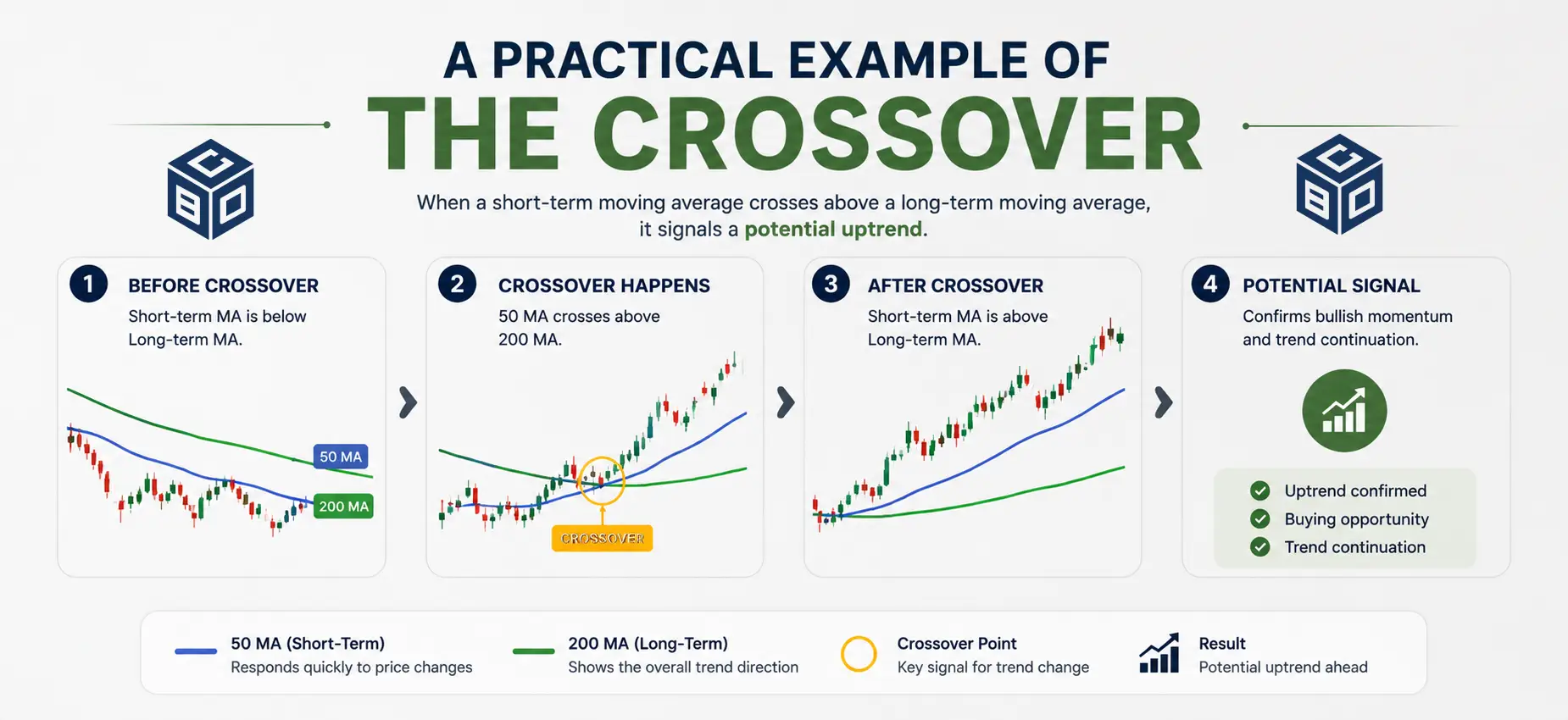
At 25,000, offset’s per-unit cost has dropped substantially, and if the box were corrugated rather than a folding carton, flexo would likely undercut it further, assuming the artwork can be simplified to fewer colors.
The exact crossover moves with color count, board type, finishing, and how busy the press schedule is. But the shape of the curve holds everywhere. Ask any supplier to show you pricing at three quantities rather than one, and you will see it in their own numbers.
Preparing artwork so the method works for you
Whichever process you land on, a few things save real money at the file stage. Request the dieline before designing, and build the artwork onto it, not around a guess. Keep critical elements away from folds and glue flaps. Set bleed generously; die-cutting has more variance than trimming.
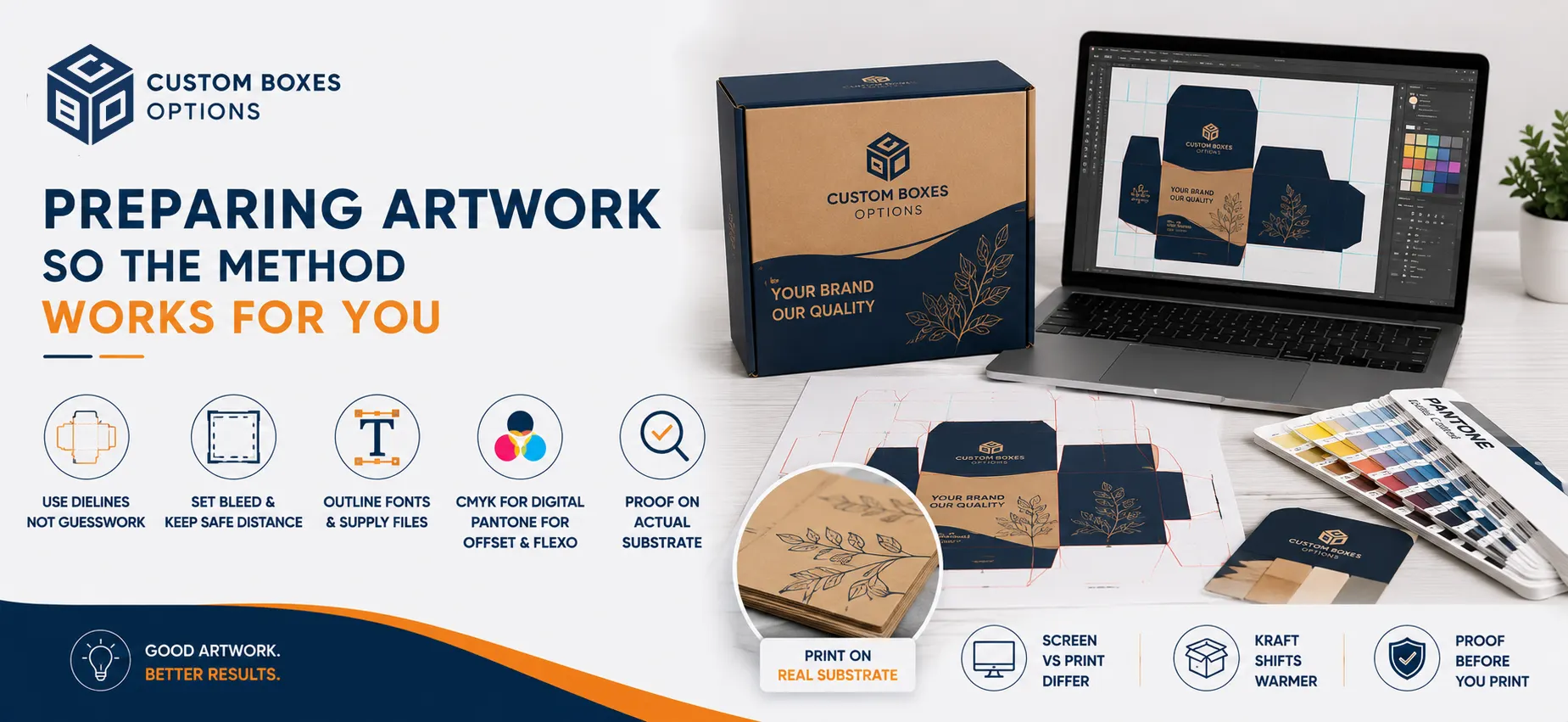
Convert type to outlines and supply fonts. Build files in CMYK if you are going digital, and specify Pantone values explicitly if you are going offset or flexo. If your design uses fine reversed-out type under 6pt and you are heading to flexo, expect it to fill in, thicken the strokes,s or move that content elsewhere.
Ask for physical proof on your actual substrate. Screen color and printed color diverge, and unprinted kraft, in particular, shifts everything warmer than a monitor suggests. Anyone ordering custom kraft paper or kraft-board boxes should plan for that shift rather than be surprised by it.
Common questions – FAQs
1. Is digital printing lower quality than offset?
Not lower, different. Modern digital output is sharp and consistent, and most buyers cannot pick digital from offset in a blind comparison of a standard four-color box. The gap shows up in spot color accuracy, extensive solid coverage, and certain finishing combinations.
2. Can I print directly on corrugated without lamination?
Yes, with flexo and with some large-format digital presses. Direct digital print on corrugated is a growing option and useful for short-run shippers, though coverage on fluted board can show a subtle washboard texture.
3. Do plates get reused on reorders?
Generally, yes, if the artwork is unchanged and the printer stores it. Confirm storage terms up front; some shops hold plates for a defined period, then discard them.
4. Which method is most sustainable?
It depends more on your substrate and ink than your press. Flexo’s water-based inks and inline efficiency give it a strong profile at volume; digital’s zero plate waste and minimal make-ready waste make it strong at low volume. Recycled and recyclable board choices move the needle more than the printing method does.
5. What if my order sits right at a crossover point?
Ask for both quotes. A reputable packaging supplier will run the numbers both ways rather than steering you to whichever press is free. If a supplier refuses to explain which method they are quoting, that is worth noting.
Where to go from here
The right printing method is the one that matches your volume, your color requirements, and what the box is actually doing for your business. There is no universally best process, only a best fit, and it changes as you scale.
If you are unsure which side of the crossover your order falls on, send us the quantity, the dimensions, the board, and the number of colors in your artwork. We will tell you which method we would run it on and why, including the cases where the honest answer is that a shorter digital run now beats committing to plates for volume you are not ready to move.
Browse our full range of custom box printing & packaging options to see what is available, or ask us for a printed sample on your chosen board before you commit to a full run. Holding the material is worth more than any spec sheet.