

Custom Hang Tags
Get a Free Quote
Get In Touch
Share Your Details
We’ll create a design and 3D mock-up for your approval.
Customization
Approve the design to start the production of your bulk boxes.
Free Delivery
Avail of free shipping on both no minimum and bulk packaging orders.

Free 3D Mockup
Finalize the order to enjoy the free 3D packaging design mockup.
Quality Assurance
Providing the promised quality of custom packaging boxes wholesale.
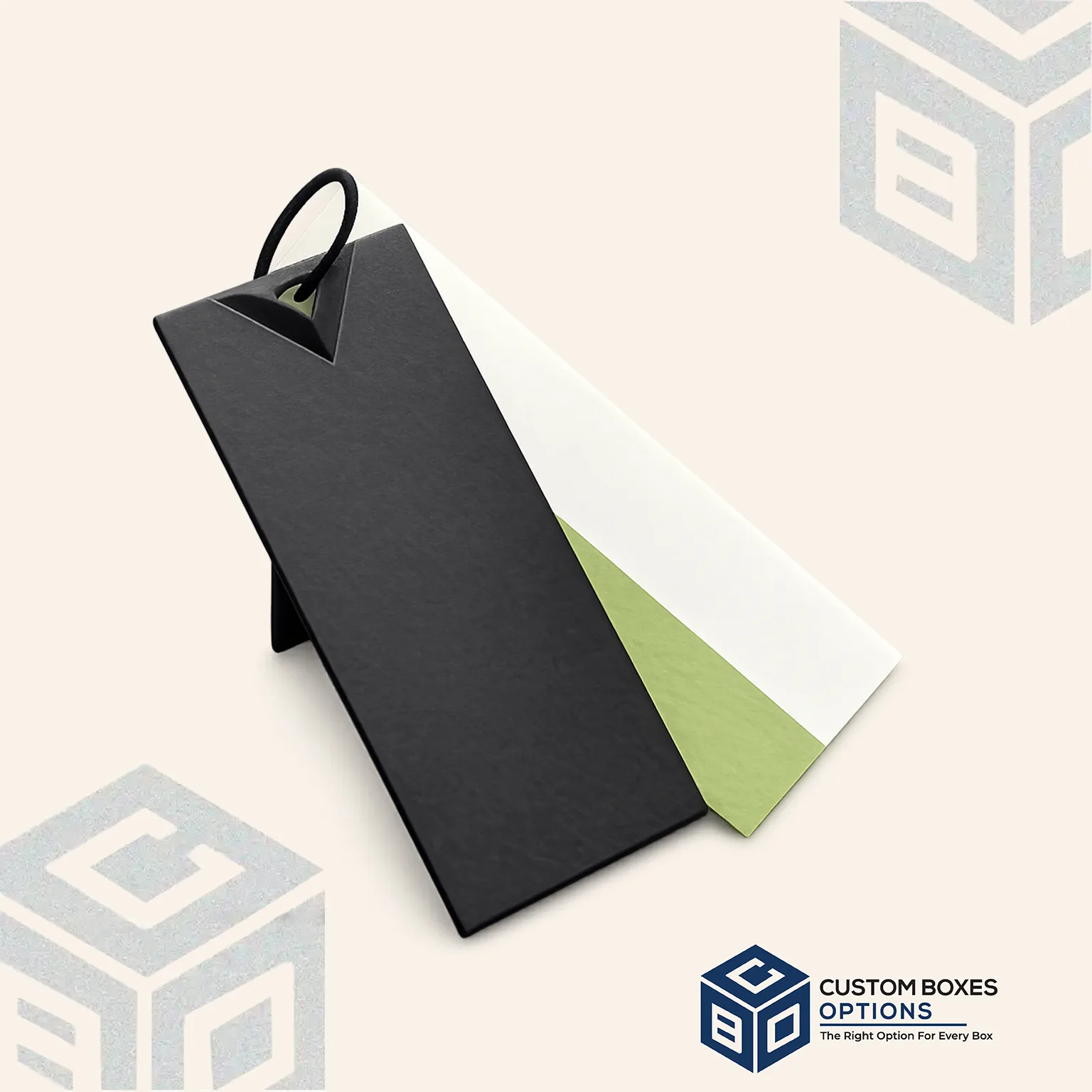
Custom Hang Tags are the smallest piece of packaging most brands order and the one a customer handles the longest. A shopper turns the tag over, checks the price, reads the fiber content, and forms a judgment about the product before trying it on. That makes the tag a brand asset and a compliance document at once. We manufacture custom packaging & print eleven-plus tag formats across shapes, finishes, and applications, on premium board and synthetic stock, drilled and reinforced, supplied pre-strung or loose. Panel space is sized around mandatory labeling rather than squeezed in once the artwork is locked.
Start With Shape, Not Finish
Shape determines two things at once: how much usable print area you get, and where the tag fails during retail handling. Both matter more than the finish you put on top.
Rounded-corner Custom Hang Tags are the sensible default. A square corner is the first part of any tag to bend, fray, and curl on a busy rail. Rounding it costs almost nothing at the die stage and keeps the full print area of a rectangle. If you’re unsure where to start, start here.
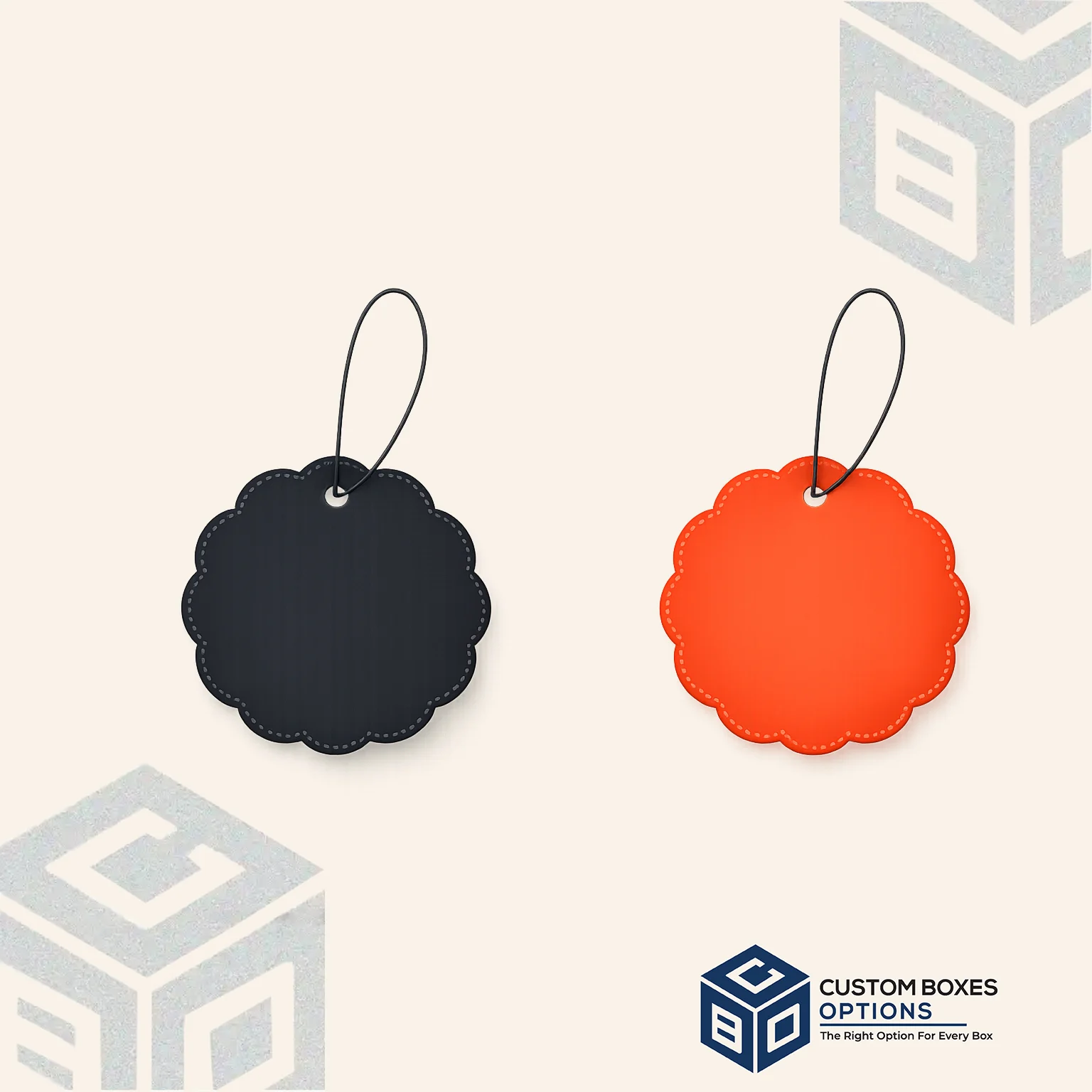
Circle Custom Hang Tags eliminate corners entirely, so there’s nothing to catch or bend. The trade-off is print area — a circle gives you noticeably less usable space than a rectangle of the same width, which matters if you’re carrying required copy. Popular with natural, organic, and handmade positioning.
Oval Custom Hang Tags recover some of that lost area by elongating the shape, and they read slightly more traditional than a circle. A common choice for heritage brands, artisan food, and beverages.
Half-circle Custom Hang Tags pair a flat top edge with a curved base. The flat edge is the practical part; it sits more stably against a garment or seam than a fully curved tag, and it gives the drill hole a proper margin.
The cut Custom Hang Tags are fully custom shapes cut to your artwork. This is where the strongest shelf impact lives, particularly when the shape references the product itself. Two things to plan for: tooling costs more than a standard die, and complex outlines often need hand-stringing rather than machine, which affects both lead time and unit cost.
Then Choose the Finish
Foil hang tags use hot stamping to apply metallic leaf to specific areas, a logo, a border, or a single word. The effect is selective and genuinely brilliant, which is why it reads as premium. Foil performs best on matte or uncoated stock, where the contrast is sharpest. Keep the artwork reasonably bold, since very fine detail can fill in during stamping.
Metallic hang tags work differently, and the distinction is worth understanding before you order. Rather than stamping foil onto specific areas, metallic tags use metallic inks or a metallic-coated substrate to create sheen across the whole surface. It costs less than full-coverage foil and gives a subtler, more even shimmer, but it won’t match foil’s brilliance on a small detail.
If you want a gleaming logo, choose foil. If you want the entire tag to catch the light, choose metallic. Plenty of brands run across different product lines.
Structure: When One Panel Isn’t Enough
Folded hang tags double or quadruple your available panel space by folding rather than enlarging the tag footprint. This is the practical answer to the compliance problem described below — the front carries your brand, the inside panels carry fiber content, care instructions, sizing, and manufacturer details, and the tag still looks clean on a rail.
Folded formats also suit brand storytelling, care guides, and multi-language markets where a single panel simply cannot hold the required copy at a legible type size.
Then Match to Your Application
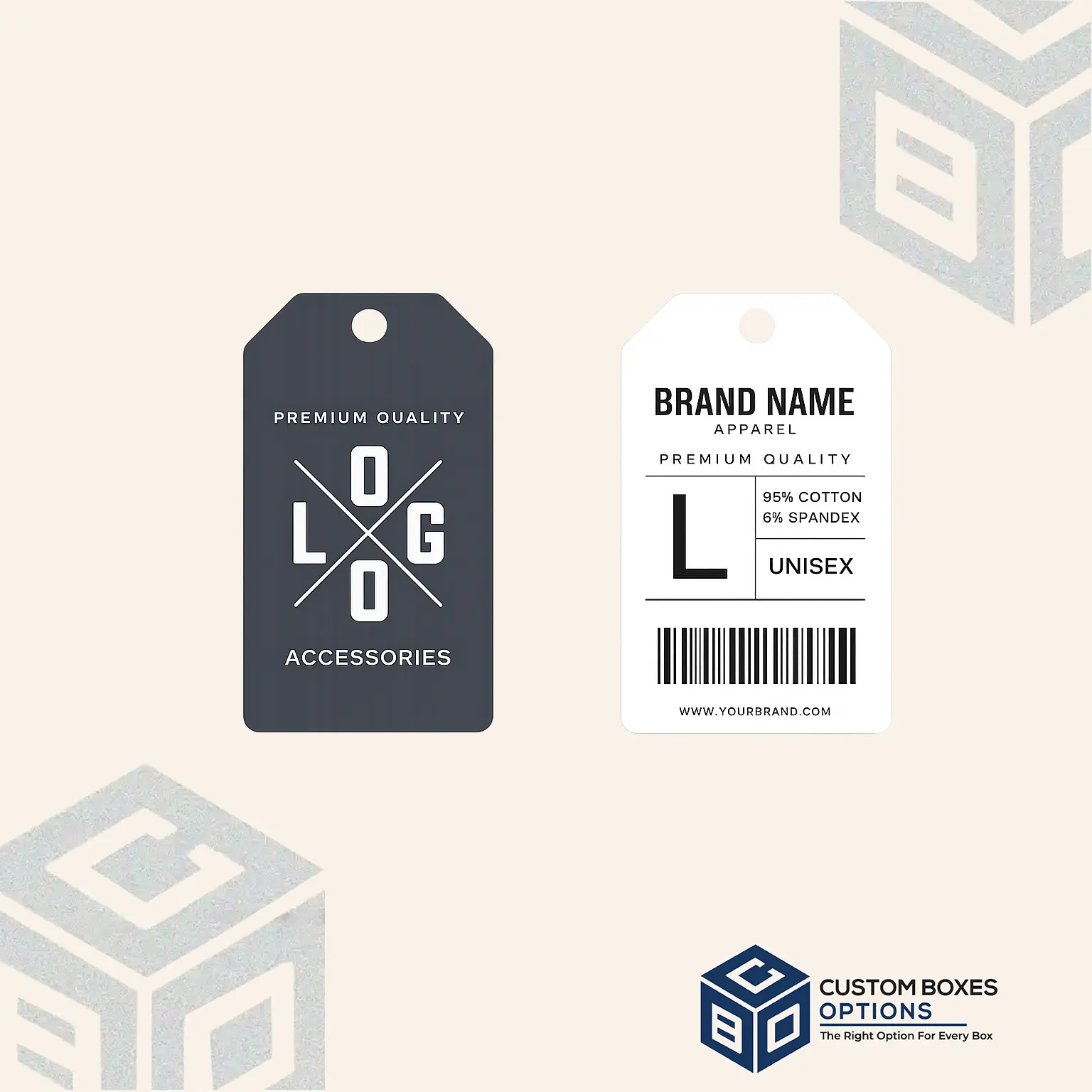
Clothing hang tags are the apparel workhorse and where labeling obligations bite hardest. Sizing, fiber content, care, and brand all compete for the same surface, which is why folded formats are so common in this category.
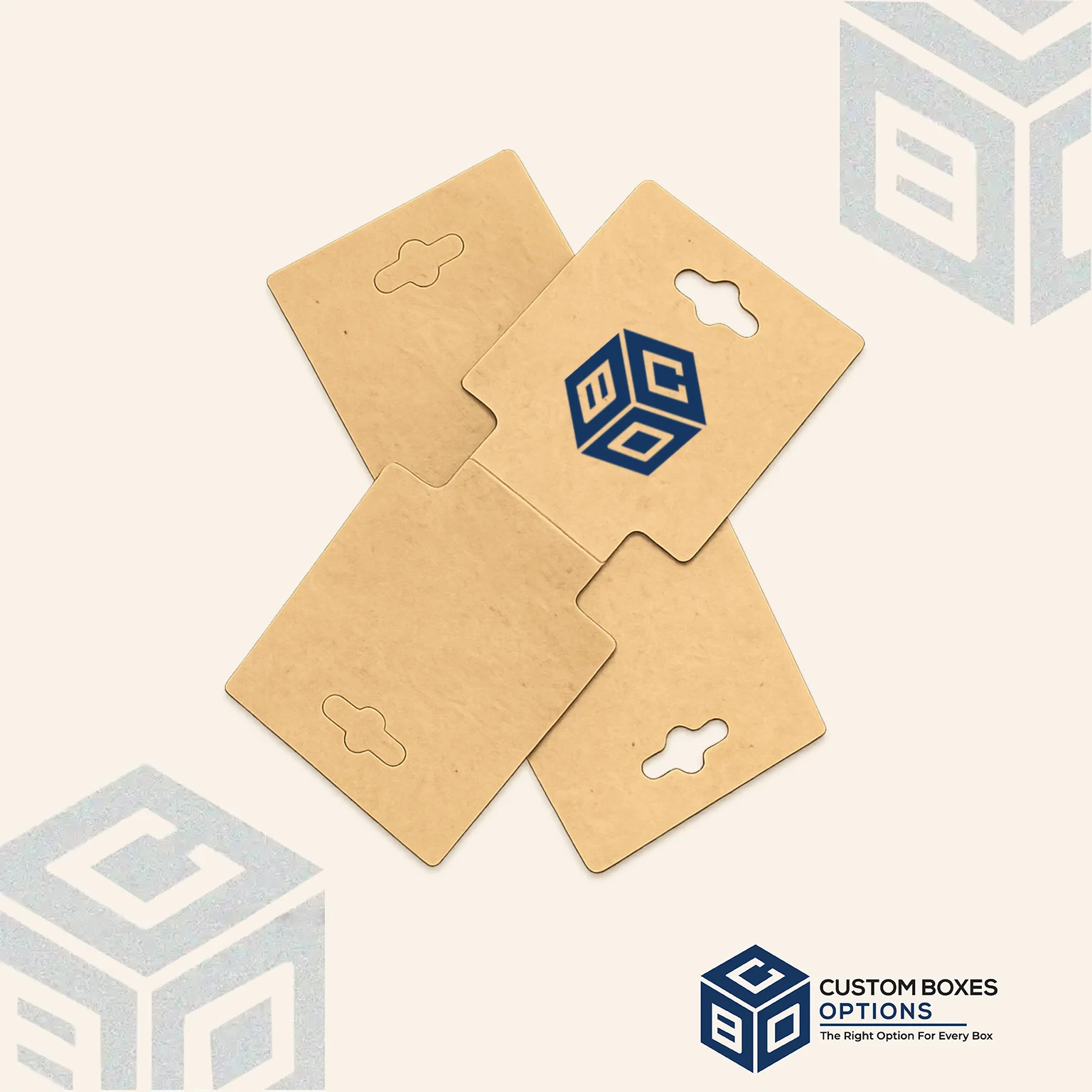
Jewelry hang tags run small and often need a slit or notch rather than a drilled hole, so a chain or ring can pass through. Precious metal claims carry their own FTC guidance around karat marking and quality descriptions, so the panel needs room for accurate marking alongside the price.
Retail hang tags prioritize function: price, SKU, and barcode. One detail worth getting right: barcodes need clear margins on either side to scan reliably. A tag sized too tight, or artwork crowding the code, causes checkout failures that store staff will remember. Plan the quiet zone at the layout stage.
The Compliance Requirement Most Suppliers Skip
Textile and apparel products sold in the US carry labeling obligations under the FTC’s Textile and Wool Acts. Depending on the product, required disclosures typically include fiber content by percentage, country of origin, and manufacturer identity or an RN number issued by the FTC. Care instructions fall under a separate rule.
Some of that can live on a sewn-in label rather than the tag. But where the brand chooses to carry it on the hang tag, or where no practical sewn-in option exists, the space has to be there, and the type has to be legible.
We size tags with that requirement accounted for. One honest limit: we’re a printer, not a compliance advisor. We build the panel space and set the copy you supply, but the content itself should be reviewed by someone qualified in textile labeling before it goes to print. Fiber content errors are a regulatory exposure, not a design revision.
Board Weight and Why Tags Fail at the Hole
For most apparel applications, 14pt to 18pt board is the practical range. Thinner stock curls during handling and reads cheap in hand. Above 24pt, drilling and stringing slow down, and cost climbs faster than perceived quality does. Luxury positioning is the exception, and there the same construction logic behind our rigid board formats applies.
Every hang tag failure happens in the same place: the hole. Drilled board tears out under repeated handling, particularly on a rail where shoppers pull garments toward them. A metal eyelet solves it permanently and adds a visible quality cue. Drill diameter should match the fastener, roughly 1/8″ for plastic loop fasteners, more for string and ribbon, and the hole needs a sensible margin from the top edge, since one drilled too close will tear regardless of reinforcement.
Attachment Methods
Cotton string reads as natural and artisanal. Waxed cord and twine suit workwear and outdoor positioning. Elastic loops slip over a button without tying, speeding up assembly. Satin ribbon signals premium and suits gifting. Plastic barb fasteners are the fastest in volume with a tagging gun. Safety pins and metal clips suit knitwear where a barb would damage the fabric.
Ask for pre-strung if you’re assembling at scale; hand-stringing thousands of tags in-house is a labor cost most brands only discover after the first delivery arrives.
Materials
Coated board gives the sharpest color and suits photography. Uncoated and textured stock feels better in hand and takes debossing beautifully, though color reproduces softer. Kraft board signals natural positioning and pairs well with the unbleached stock in our kraft paper range. Recycled board works where a sustainability claim needs to hold up; the PCW distinctions we set out on our recycled tissue page apply equally here. Synthetic stock is tear- and water-resistant, suiting swimwear and outdoor gear.
Where Hang Tags Fit Your Wider Packaging
Tags rarely stand alone. Apparel brands typically run them alongside branded mailer boxes for direct shipping, printed tissue for the unboxing layer, and a closing seal from our labels and stickers range. Gifting lines pair tags with rigid presentation boxes, and pet accessory brands often need both tags and the peg-ready construction covered on our hanger card page.
Ordering the set through one custom packaging and print supplier keeps a single color reference across coated board, uncoated tag stock, and printed tissue, three surfaces that reproduce the same ink noticeably differently.
Specification Summary
| Attribute | Detail |
|---|---|
| Shapes | Rectangle, rounded corner, circle, half circle, oval, folded, custom die cut |
| Sizes | All custom sizes |
| Stock range | 12pt to 24pt board, rigid and synthetic options |
| Materials | Coated board, uncoated, kraft, recycled, synthetic, metallic substrate |
| Printing | CMYK, CMYK + PMS, 1–3 spot colors, metallic inks |
| Finishing | Gloss, matte, soft-touch, spot UV, foil stamping, embossing, debossing, painted edges |
| Hole options | Drilled, reinforced, metal eyelet, slit or notch for jewelry |
| Attachment | Cotton string, waxed cord, elastic loop, ribbon, plastic fastener, pre-strung or loose |
| Proofing | Flat view, free 3D mockup, physical sample on request |
| Turnaround | 6–8 business days from artwork approval |
| Shipping | Free shipping across the USA |
Frequently Asked Questions – FAQs
1. What’s the difference between foil and metallic hang tags?
Foil stamping applies metallic leaf to specific areas using heat and pressure, giving a brilliant, selective shine, ideal for a logo or border. Metallic tags use metallic inks or a metallic substrate for an even sheen across the whole surface, at a lower cost for full coverage but with less brilliance on fine detail. Choose foil for a gleaming logo, metallic for an overall shimmer.
2. Which hang tag shape should I choose?
Rounded corners are the safe default, it keeps full print area while removing the corners that bend first on a rail. Circles and ovals suit natural and heritage positioning but give you less usable space for required copy. Die-cutting delivers the most impact but costs more in tooling and often needs hand-stringing.
3. What information is legally required on a clothing hang tag?
US textile products carry FTC disclosure requirements typically covering fiber content by percentage, country of origin, and manufacturer identity or RN number, with care instructions governed separately. Some of this can sit on a sewn-in label instead. Folded tags are the usual solution when a single panel cannot hold everything legibly. The content itself should be reviewed by a textile labeling specialist before print.
4. Do you supply hang tags pre-strung?
Yes. We machine-string standard tags and hand-string more complex die-cut shapes. For volume assembly, pre-strung is almost always cheaper than the in-house labor of stringing thousands by hand.
5. How do I stop hang tags from tearing at the hole?
A metal eyelet is a durable fix and adds a quality cue at the same time. Hole placement matters too; one drilled too close to the top edge will fail regardless of reinforcement.
6. What board weight works best?
14pt to 18pt suits most apparel: heavy enough to resist bending, light enough to drill and string efficiently. Below 12pt tends to curl. Luxury positioning justifies heavier rigid stock.
7. What’s the minimum order quantity?
Standard specifications start at 100 units. Custom die-cut shapes, eyelets, or specialty finishes may carry a higher minimum, and we state that figure before you commit rather than after.
Closing Lines
Send us your tag dimensions, shape preference, attachment method, and whether the tag carries mandatory labeling. We’ll come back with a full specification and a free 3D mockup before anything goes to production.
Request your free quote for Custom Hang Tags today.