
Most guides to UV printing tell you the ink dries fast and the colors look sharp. Both are true, and neither helps you decide anything. What matters when you are ordering packaging is different: whether the ink will crack when the box is scored, whether the glue will hold on a cured surface, whether the ink is legal to run near food, and whether the extra cost buys you anything a good aqueous coating wouldn’t. Those are the questions we get on the phone at CBO – Custom Boxes Options, and they are the ones this guide answers.
If you want the surface-level version, it is two sentences: UV printing uses inks that cure instantly under ultraviolet light instead of drying by evaporation, which makes them sharp, durable, and printable on materials that normally reject ink. Everything below is the part that actually affects your order. UV printing is also one from different box printing types used in the packaging manufacturing.
What is actually happening when UV ink cures
Conventional ink dries. UV ink does not dry, it polymerizes.
Standard offset ink contains solvents and oils that either soak into the paper or evaporate into the air, leaving pigment behind. That takes hours, sometimes overnight, and it is why conventionally printed sheets sit on skids before anyone can finish them.
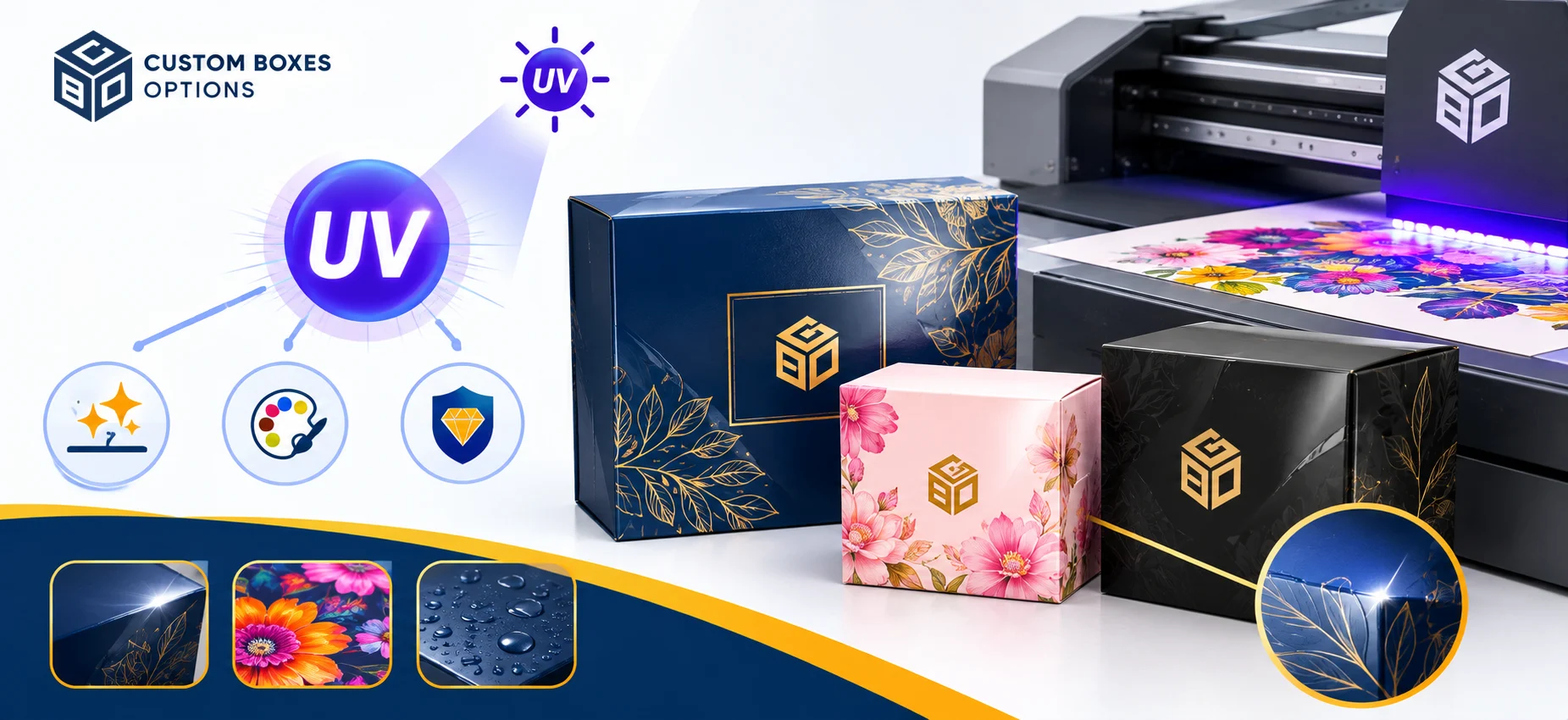
UV ink contains no evaporating solvent. Instead it carries monomers, oligomers, and photo initiators. When ultraviolet light hits the film, the photo initiators fracture and trigger a chain reaction that links the monomers into a solid polymer network. The liquid becomes a solid plastic film in a fraction of a second.
That distinction explains every advantage and every limitation UV printing has. Because nothing evaporates, almost 100% of what is laid down stays on the sheet, so ink films are dense and colors sit up brightly. Because the ink does not soak in, it works on non-absorbent surfaces where conventional ink would never set. And because the result is a hard polymer film rather than pigment embedded in fiber, it behaves differently when you fold it, glue it, or recycle it.
There are two chemistries worth knowing by name
- Free-radical UV inks are the industry standard, fast, well understood, and slightly inhibited by oxygen at the very surface.
- Cationic UV inks cure by a different mechanism, continue curing after the light source, and adhere better to certain plastics and metals, but they are slower and more sensitive to humidity. For most paperboard packaging, you are getting free-radical chemistry.
Mercury lamps, LED, and why the difference shows up on your invoice
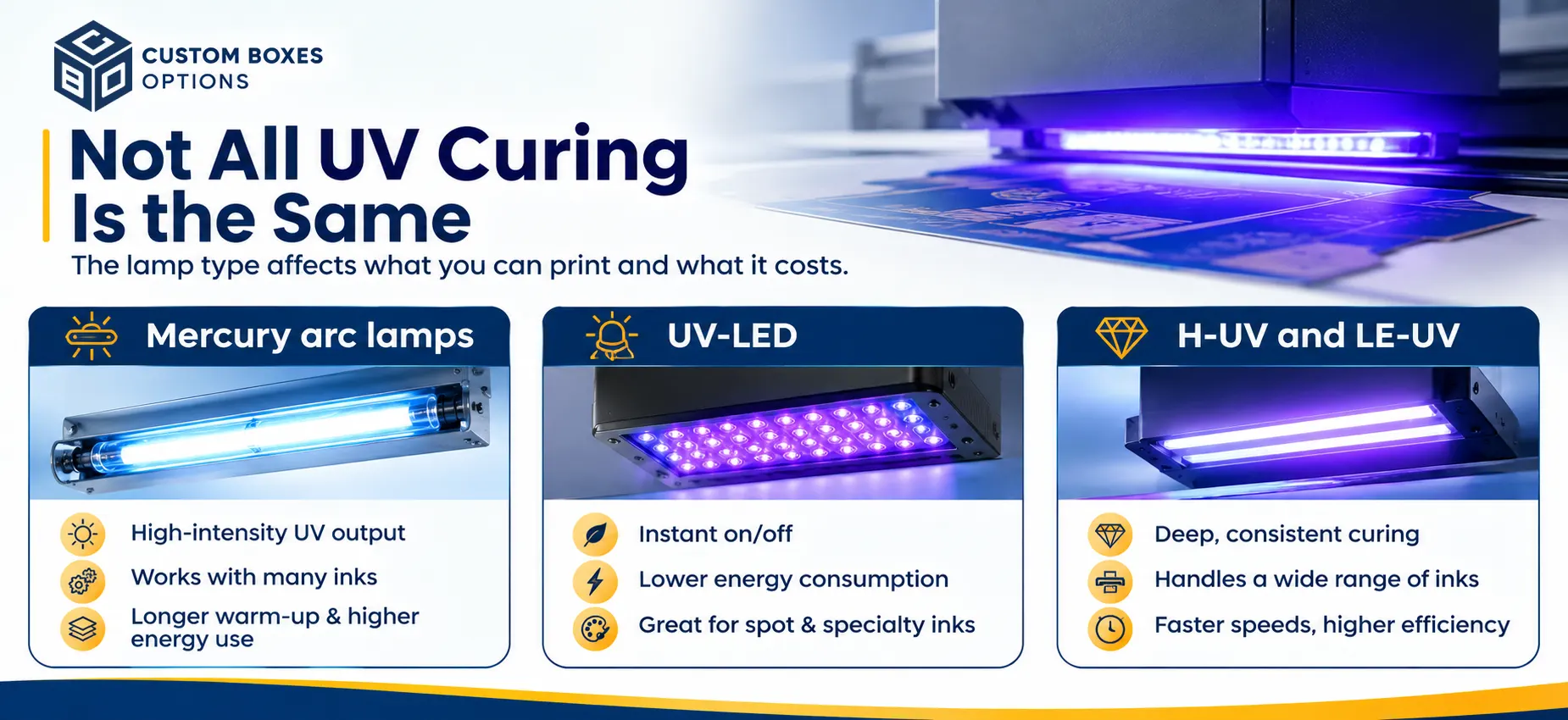
Not all UV curing is the same, and the lamp type affects both what can be printed and what it costs.
- Mercury arc lamps are the traditional source. They emit across a broad UV spectrum, cure aggressively, and run extremely hot. That heat is a genuine constraint, it can distort thin plastics and dry out board, and the lamps generate ozone, which requires extraction. They also need warm-up time and consume power continuously, whether or not sheets are running.
- UV-LED curing emits a narrow band, typically around 385 to 395 nanometers. It runs cool, switches on and off instantly, contains no mercury, produces no ozone, and uses considerably less energy. The trade-off is that LED requires inks formulated with photo initiators tuned to that narrow wavelength, and surface cure can be slightly softer because the narrow band interacts differently with oxygen inhibition.
- H-UV and LE-UV systems sit between the two, low-energy mercury lamps paired with hypersensitive ink formulations, common on sheet fed offset presses.
Why this matters commercially: a shop that has converted to LED-UV has lower running costs and can print on heat-sensitive stock, but the ink is more expensive per kilogram. A shop still on mercury arc may quote cheaper ink but carries higher energy overhead. Neither is inherently better for you but if your job involves thin film, laminated board, or anything that warps under heat, ask which system the press uses before you approve a proof.
Where UV printing genuinely earns its cost
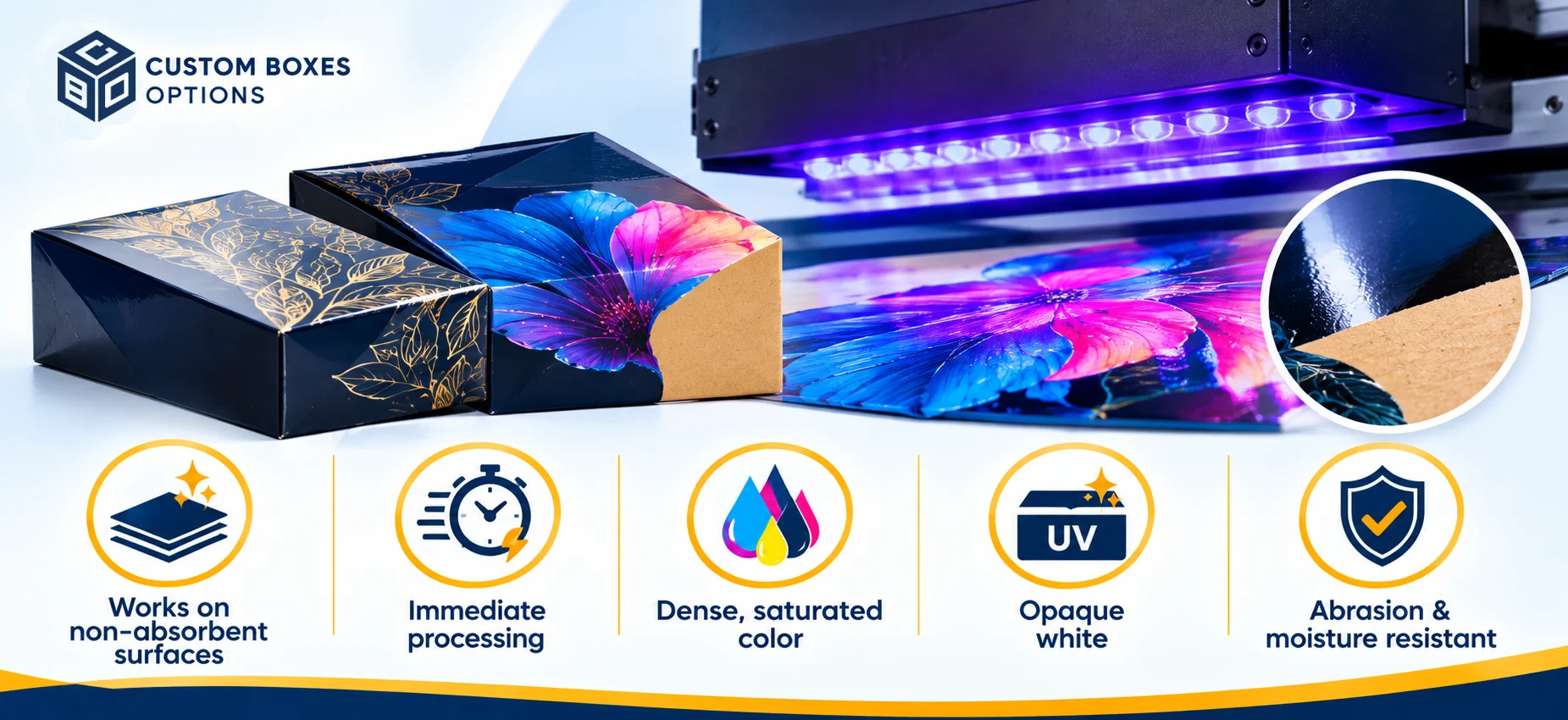
- Non-absorbent and coated surfaces. This is the strongest case. Heavily coated boards, laminated stock, foil boards, metallized films, and plastics all reject conventional ink because there is nowhere for it to soak. UV ink cures on top of the surface rather than into it, so those substrates become printable. If your packaging involves a foil-laminated carton or a gloss-laminated rigid box, UV is often not a preference but a requirement.
- Immediate downstream processing. Sheets come off the press cured, which means die-cutting, foil stamping, folding, and gluing can start immediately instead of after an overnight set. On a tight schedule that removes a full day, sometimes more. For seasonal or launch work with a hard shelf date, that alone can justify the process.
- Dense, saturated color. With no solvent leaving the film, UV ink holds its pigment load and sits up on the surface. Solid blocks look deeper. Fine reversed-out type stays clean because the ink does not spread as it absorbs. On uncoated or Kraft-style stock, where conventional ink sinks in and goes flat, the difference is very visible, worth knowing if you are printing on custom Kraft paper or natural-board packaging.
- Opaque white. Conventional white on dark or transparent substrate is weak. UV white, laid down as a base layer and cured before the color pass, gives you something to print onto. This is what makes vivid artwork possible on black board, clear plastic, or metallized stock.
- Abrasion and moisture resistance. The cured film is a plastic layer, so it takes scuffing and handling better than an uncured conventional print. For packaging that ships loose, gets stacked, or sits in a humid environment, that durability is real, though it is resistance, not waterproofing.
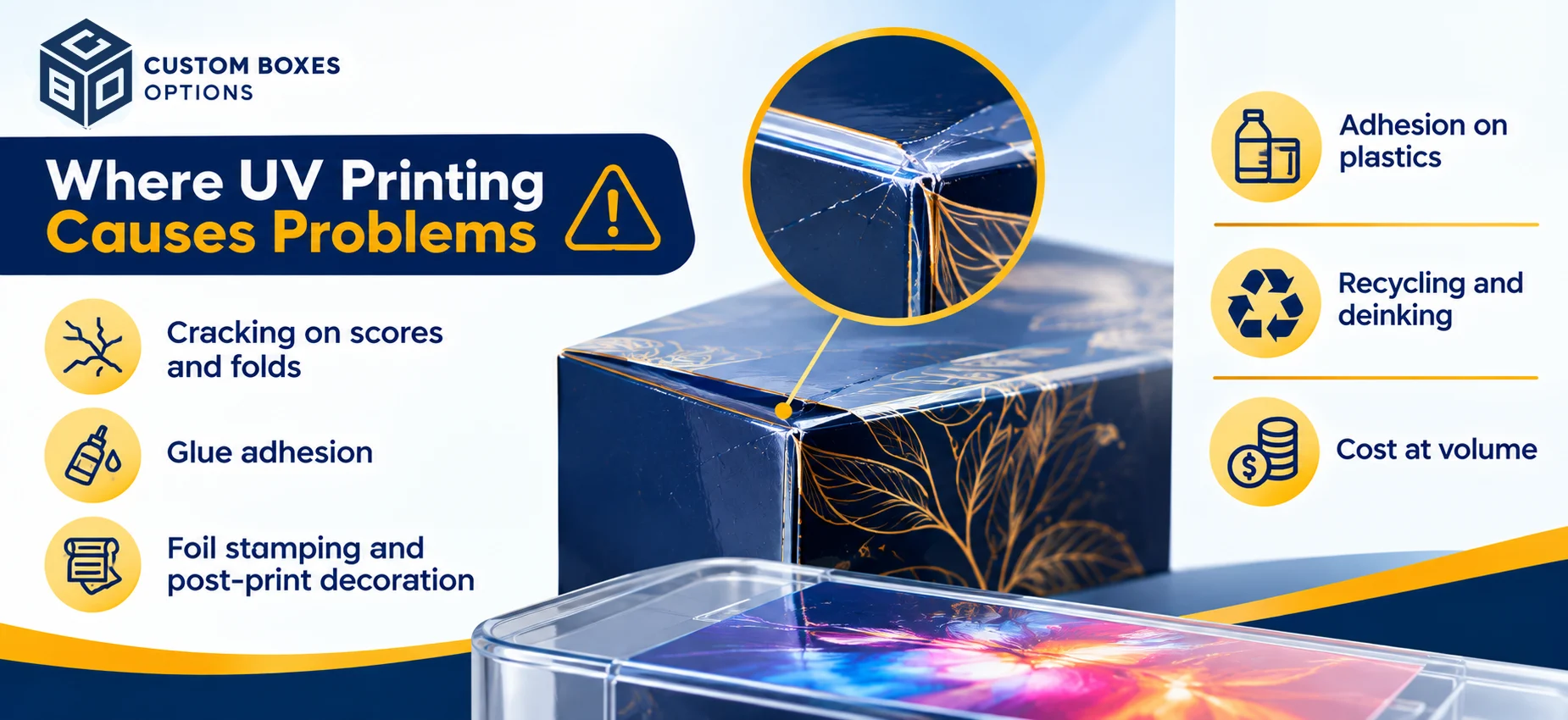
Where UV printing causes problems
This is the section most supplier guides skip, and it is the one that saves you money.
Cracking on scores and folds
A cured UV film is harder and less flexible than a conventional ink film. When board is scored and folded, the ink layer on the outside of the fold is stretched. Heavy coverage across a fold, especially dark solids, and especially on heavier board, can crack, leaving a pale line along the crease.
This is manageable but it has to be designed for. Keep heavy solid coverage off primary fold lines where the design allows. Ask the printer about flexible or fold-tolerant ink formulations if the design demands it. Score against the grain direction wherever the structure permits. And always, always check a folded physical sample rather than a flat printed sheet, cracking does not exist until the box is made up.
Glue adhesion
Cured UV ink and UV varnish create a low-surface-energy film that adhesive struggles to bond to. If glue tabs are printed or coated, the box can fail at the seam under load.
The standard fix is a glue knockout: the artwork and coating are masked so the glue tab stays bare board. Any competent packaging printer builds this in automatically, but it is worth confirming, particularly on jobs where a flood coating covers the whole sheet. Corona treatment is an alternative on some substrates.
Foil stamping and post-print decoration
Foil applied over a fully cured UV surface may not key properly. Foil selection has to match the surface it is landing on, and sometimes the sequence has to change, foil first, then print, rather than the reverse. If your design combines UV printing with foil, embossing, or an additional coating, flag it early. It affects the production order, not just the finish.
Adhesion on plastics
Ink adhering to a plastic substrate depends on surface energy, and many plastics need corona or flame treatment, or a primer, before UV ink will hold. A print that looks perfect coming off the press can be lifted with tape a day later if the surface was not properly prepared. On any non-paper substrate, ask for an adhesion test — a simple cross-hatch tape test, as part of the proof.
Recycling and deinking
Cured UV ink is a crosslinked polymer, which makes it harder to remove in deinking processes than conventional ink. In standard old corrugated container recycling streams this is generally tolerated, since the fiber is what is being recovered. In higher-grade deinking streams, UV-printed stock is less welcome and can generate visible specks in the recycled pulp.
If your brand makes recyclability claims on pack, this is a detail worth raising with your printer rather than assuming. It rarely disqualifies UV, but “recyclable” is a claim that increasingly needs to survive scrutiny.
Cost at volume
UV inks cost more than conventional inks, and UV-capable presses carry higher capital and consumable costs. For long runs of standard artwork on standard coated board with no special substrate requirement, conventional printing with an aqueous coating will usually land cheaper and look perfectly good.
UV is worth paying for when it solves a problem, substrate, schedule, opacity, durability. It is not worth paying for as a default upgrade.
The food packaging question nobody wants to answer plainly
This is the biggest gap in most UV printing guides, and if you package food you need to read it.
UV inks contain photo initiators. If curing is incomplete, unreacted photo initiator and residual monomer remain in the film, and those can migrate. Migration can happen straight through porous board, or by set-off, where the printed face of one sheet transfers residue onto the unprinted reverse of the sheet stacked on top of it. That reverse side may end up as the inside of a food carton.
This is not theoretical. In 2005, the photo initiator ITX was detected in packaged infant milk in Europe, traced to UV-printed cartons, and it triggered a product recall and a permanent change in how the industry handles ink migration. The response was the development of low-migration UV ink systems and formal industry guidance, including EuPIA’s good manufacturing practice for printing inks on food contact materials and the Swiss Ordinance list of permitted substances.
What this means for you, practically:
- If your packaging has direct or indirect food contact, specify low-migration UV inks. Do not assume standard UV inks are appropriate.
- Ask your printer to confirm cure is being verified, not assumed. Reputable operations run solvent rub tests, tape tests, or instrumented checks, and record them.
- Ask whether a functional barrier exists between the printed surface and the food, an inner liner, a bag, a coating.
- Request documentation. A supplier who cannot produce ink compliance statements for a food job is telling you something.
None of this makes UV unusable for food packaging, low-migration systems are used routinely across the sector. It makes UV something you specify carefully rather than order casually. Anyone ordering food packaging or greaseproof and food-contact papers should raise this at quote stage, not after the run.
The same applies with equal force to pet food. Migration standards for pet food and treat packaging are held to comparable expectations, and the substrate is often the same coated board.
UV printing vs. spot UV vs. UV coating vs. aqueous coating
Four terms, constantly confused, doing four different jobs.
| UV printing | Spot UV | UV flood coating | Aqueous coating | |
|---|---|---|---|---|
| What it is | The printing process itself | Clear gloss on selected areas | Clear gloss over the whole sheet | Water-based clear coating |
| Applied | As the artwork | After printing | After printing | After printing, inline |
| Purpose | Creates the image | Visual and tactile contrast | Gloss and scuff resistance | Light protection, fast, cheap |
| Gloss level | Depends on artwork | High, localized | High, overall | Matte to satin |
| Typical cost | Higher ink cost | Adds a pass and often a plate | Moderate | Lowest |
| Recyclability | Standard streams generally accept | Same | Same | Best of the four |
The one to remember: spot UV is not UV printing. Spot UV is a finishing effect, a clear varnish applied to chosen areas so a logo or pattern catches the light against a matte background. You can have spot UV on a conventionally printed box, and you can have UV printing with no spot UV anywhere. They are independent decisions.
Aqueous coating is the quiet workhorse. For a large share of packaging jobs it delivers adequate protection at a fraction of the cost, recycles more easily, and is the sensible default unless something specific pushes you elsewhere.
A decision framework
Work through these in order.
- Is your substrate non-absorbent? Foil board, laminated stock, plastic, metallized film. If yes, UV is likely the only practical route and the rest of the questions are secondary.
- Do you need opaque white on a dark or clear surface? If yes, UV.
- Is your schedule genuinely tight? If removing a day of drying time changes whether you make your date, UV pays for itself in logistics.
- Is the pack going to be handled hard? Retail packaging that gets browsed, boxes that ship loose, retail cartons that sit on shelf for months, the abrasion resistance matters.
- Is any of the above true? If none are, conventional printing with aqueous coating is probably the better commercial answer, and a supplier steering you to UV anyway is worth questioning.
- Then, before you commit: confirm low-migration inks if food is involved, confirm glue knockouts, confirm fold behavior on a made-up sample, and confirm the substrate has been adhesion-tested if it is not paperboard.
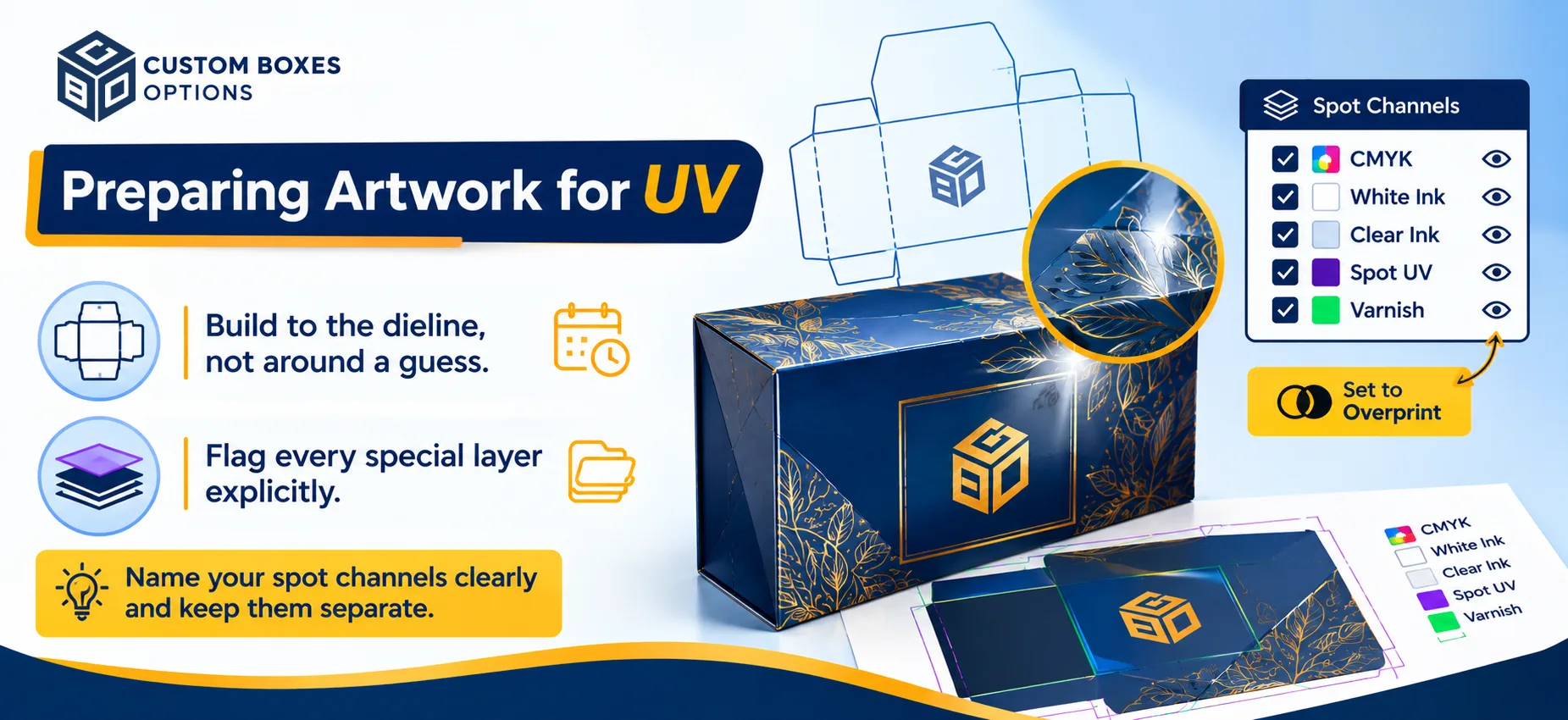
Preparing artwork for UV
Build to the dieline, not around a guess. Request it before design starts.
Flag every special layer explicitly. White ink, clear ink, spot UV, and varnish each need their own separate spot channel in the file, named clearly, set to overprint. Do not embed them in the CMYK artwork and expect the prepress team to interpret your intent.
Keep heavy solid coverage away from fold lines where the design allows, and thicken fine reversed type slightly if it sits in a dense solid.
Specify Pantone targets by number rather than describing them. UV inks can shift slightly against their conventional equivalents because the film sits differently on the surface, so if a brand color is critical, ask for a drawdown on your actual stock.
Ask for a made-up sample, not a flat proof. A flat sheet cannot show you cracking on a score, glue seam performance, or how the gloss reads on a folded panel. This applies to small items too, hang tags with spot UV read completely differently in hand than on screen.
Frequently asked questions
1. Is UV printing waterproof?
No. It is water-resistant. The cured film resists moisture better than conventional ink, but the substrate underneath is still board, and board fails before the ink does. For genuine water resistance you need a barrier material or laminate, not just UV ink.
2. Will UV ink crack when the box is folded?
It can, particularly with heavy coverage on a score line. It is a design and specification issue rather than an automatic flaw. Check a folded sample before approving production.
3. Is UV printing safe for food packaging?
With low-migration ink systems, verified cure, and appropriate barriers, yes, it is used across the food sector. With standard UV inks and unverified cure, it carries real migration risk. The distinction is the specification, not the technology.
4. Is UV printing the same as digital printing?
No, though they overlap. UV describes the ink and curing chemistry. Digital describes the imaging method. UV inkjet is both. UV offset is UV but not digital. Conventional toner digital is digital but not UV.
5. Does UV printing cost more?
The ink and press time usually cost more than conventional equivalents. Whether the total job costs more depends on what it replaces, if UV lets you skip a lamination step or hit a deadline without expedite fees, it can be the cheaper route overall.
6. Can UV printing go on corrugated?
Yes, both by UV Flexo directly onto the board and by UV Litho on a laminated Liner. Direct print on fluted board shows more surface texture than print on a laminated liner does.
7. How do I know the ink is properly cured?
Ask your printer. Standard checks include a solvent rub test, a tape pull test, and on food work, instrumented verification. A supplier who has never been asked this question before is a signal in itself.
8. Does UV printing affect recyclability?
In standard corrugated recovery, generally not meaningfully. In higher-grade deinking streams, cured UV film is harder to remove than conventional ink. If you are making specific recyclability claims, verify with your printer rather than assuming.
The honest summary
UV printing is a specification, not an upgrade. It solves particular problems extremely well, non-absorbent substrates, opaque white, compressed schedules, abrasion resistance, and it introduces particular problems that have to be designed around: fold cracking, glue adhesion, migration in food applications, and higher cost at volume.
The right question is never “should I use UV printing.” It is “what is this box made of, what does it have to survive, what is going inside it, and when do I need it.” Answer those four, and the printing method usually picks itself.
If you want a straight assessment for a specific job, send us the substrate, the structure, the contents, and the quantity. We will tell you whether UV is the right call, including the cases where it plainly is not, and a conventional print with an aqueous coating would serve you better for less money. Explore our full range of custom packaging or ask for a printed sample on your chosen stock before you commit. A folded sample in hand answers questions no spec sheet can.